Integrated Campaign Registry UNICEF
Integrated Campaign Registry

Ensuring every campaign builds on the last.

Health campaigns are expensive but essential to reaching the hard‑to‑reach. The ICR makes sure their data is reused and validated, so the investment compounds and every round that follows is cheaper and more effective.

Illustrative country
2022What the registry knows
20222023202420252026

Drag the slider. Each campaign round adds places, denominators, households, teams, and coverage to the same registry. Hover a district to see what is known about it.

Why campaigns

Campaigns are how health services reach everyone.

Funded

Governments and donors already pay to map places and reach people.

Repeat

Many run every year, in the same districts with the same teams.

Broad reach

They go where routine services do not.

Measure

They count people to set a target, then again to check it.

What the ICR is

The ICR is an open data standard for storing and integrating data across health campaigns

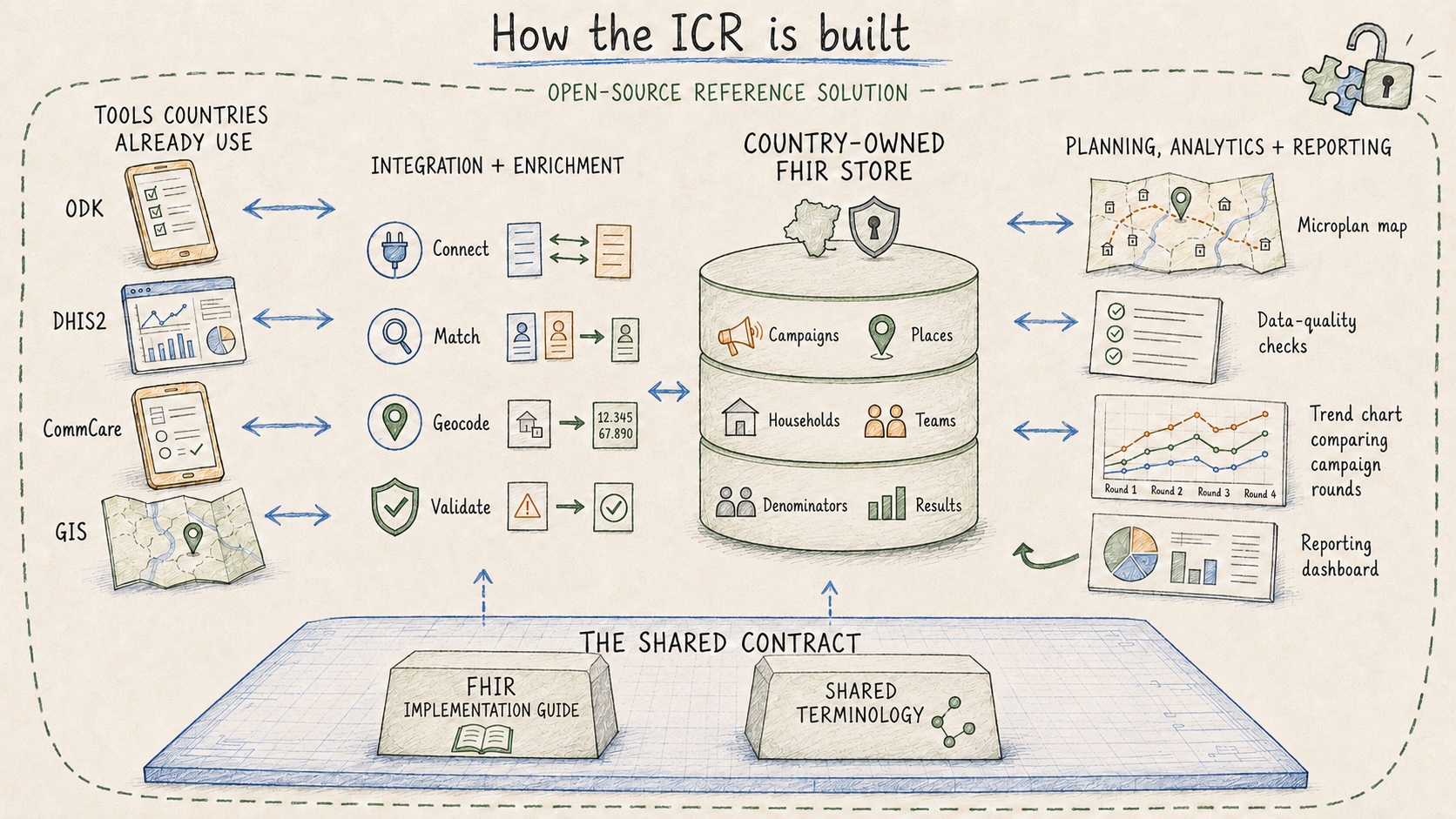
It has three parts: a FHIR Implementation Guide that defines a shared vocabulary for campaigns, a country‑owned FHIR based data registry where data across campaigns can be stored and analyzed, and an open‑source reference solution that connects the platforms countries already use, such as ODK, DHIS2, and CommCare, to that store.

What the ICR unlocks

Key ICR benefits

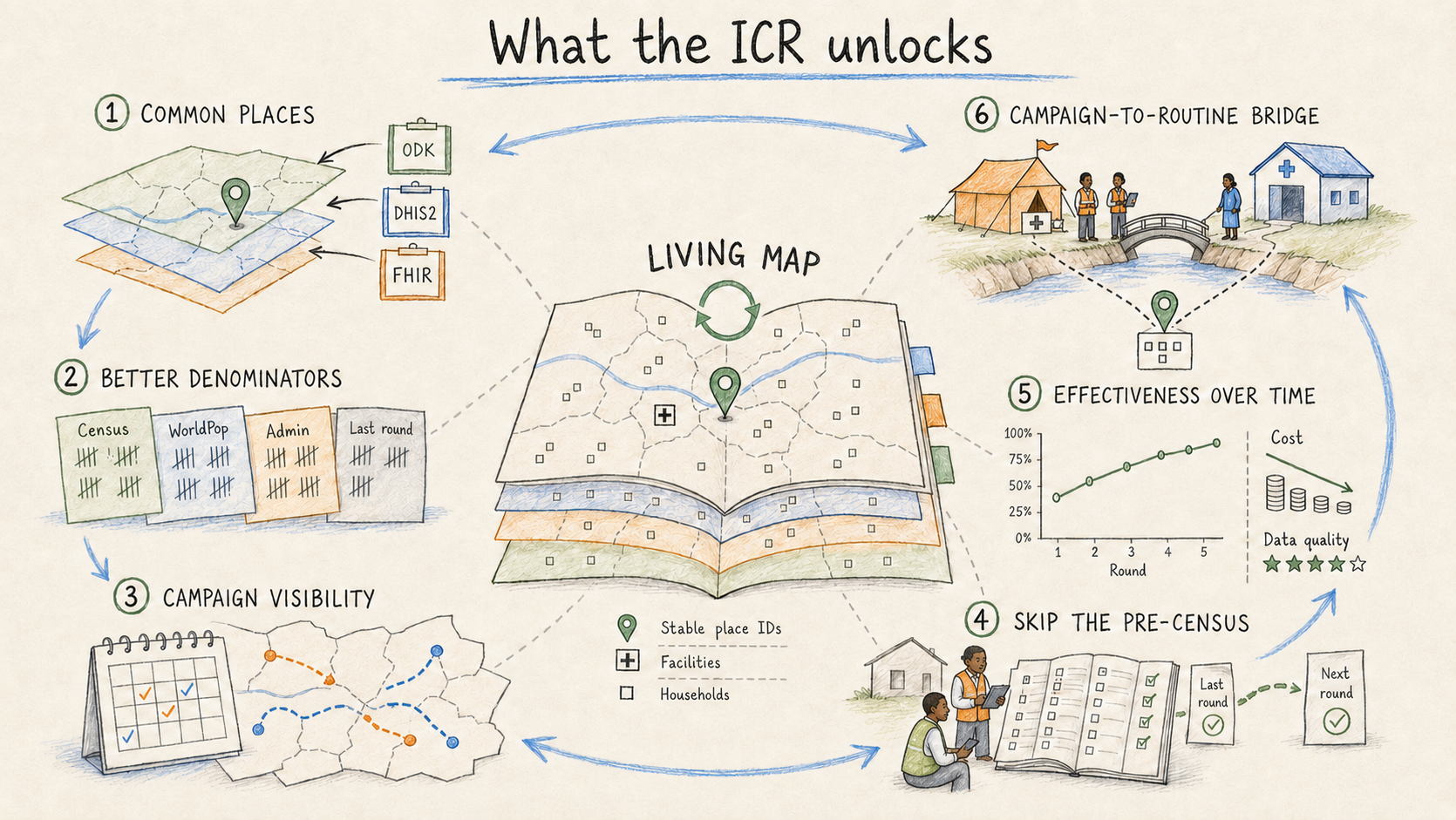
Hand-drawn overview titled 'What the ICR unlocks': a living map at the centre, surrounded by six benefits: common places, better denominators, campaign visibility, skip the pre-census, effectiveness over time, and the campaign-to-routine bridge
Click the image to open the full-size original.
Common terminology
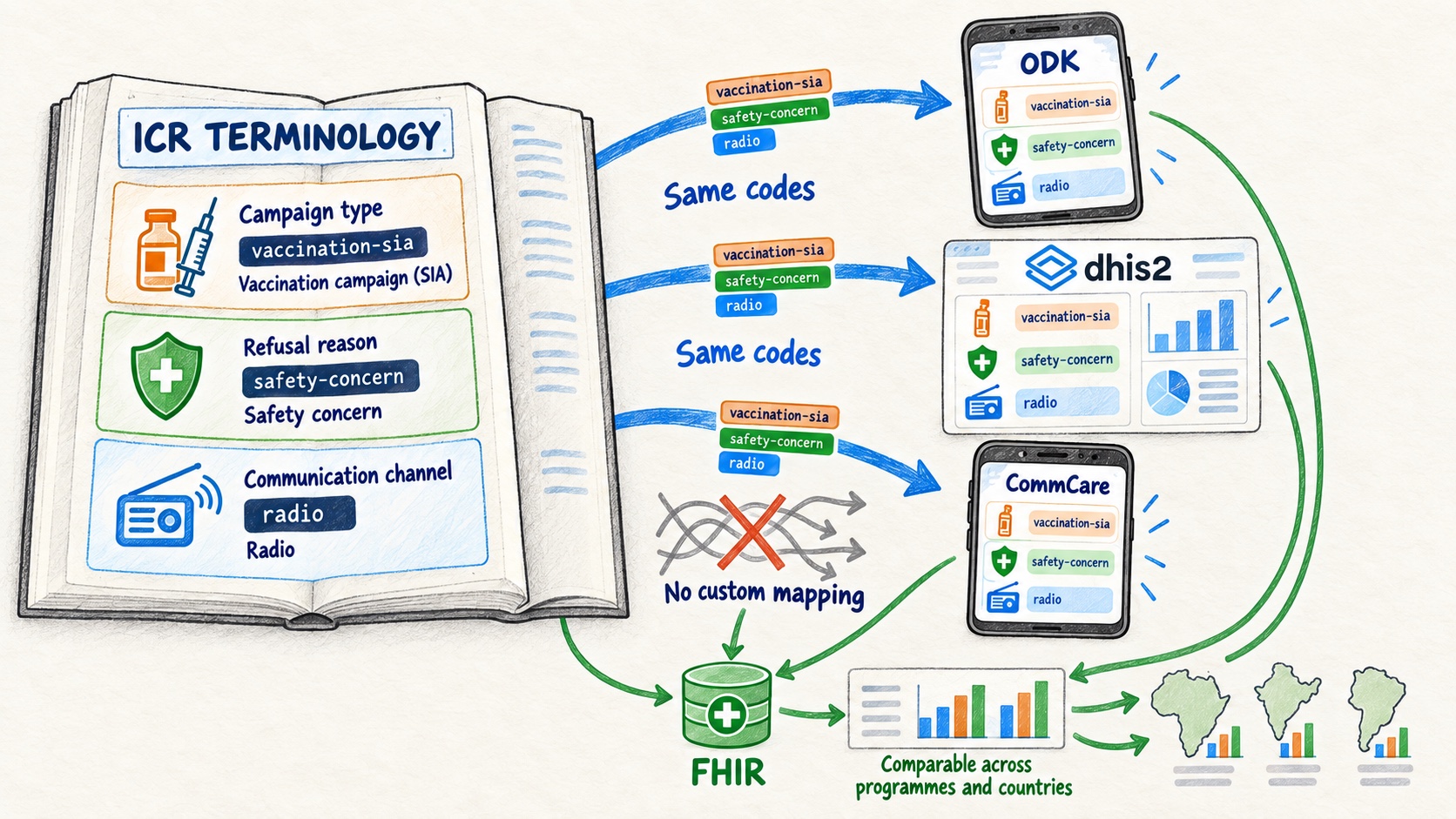
The ICR defines a shared vocabulary for campaigns: campaign types, delivery strategies, missed reasons, team roles, and more. A form built against these codes in ODK, DHIS2, or CommCare produces data the registry understands without a custom mapping. Adopting shared instruments instead of authoring them from scratch makes results easier to compare across programmes and countries.
Common places
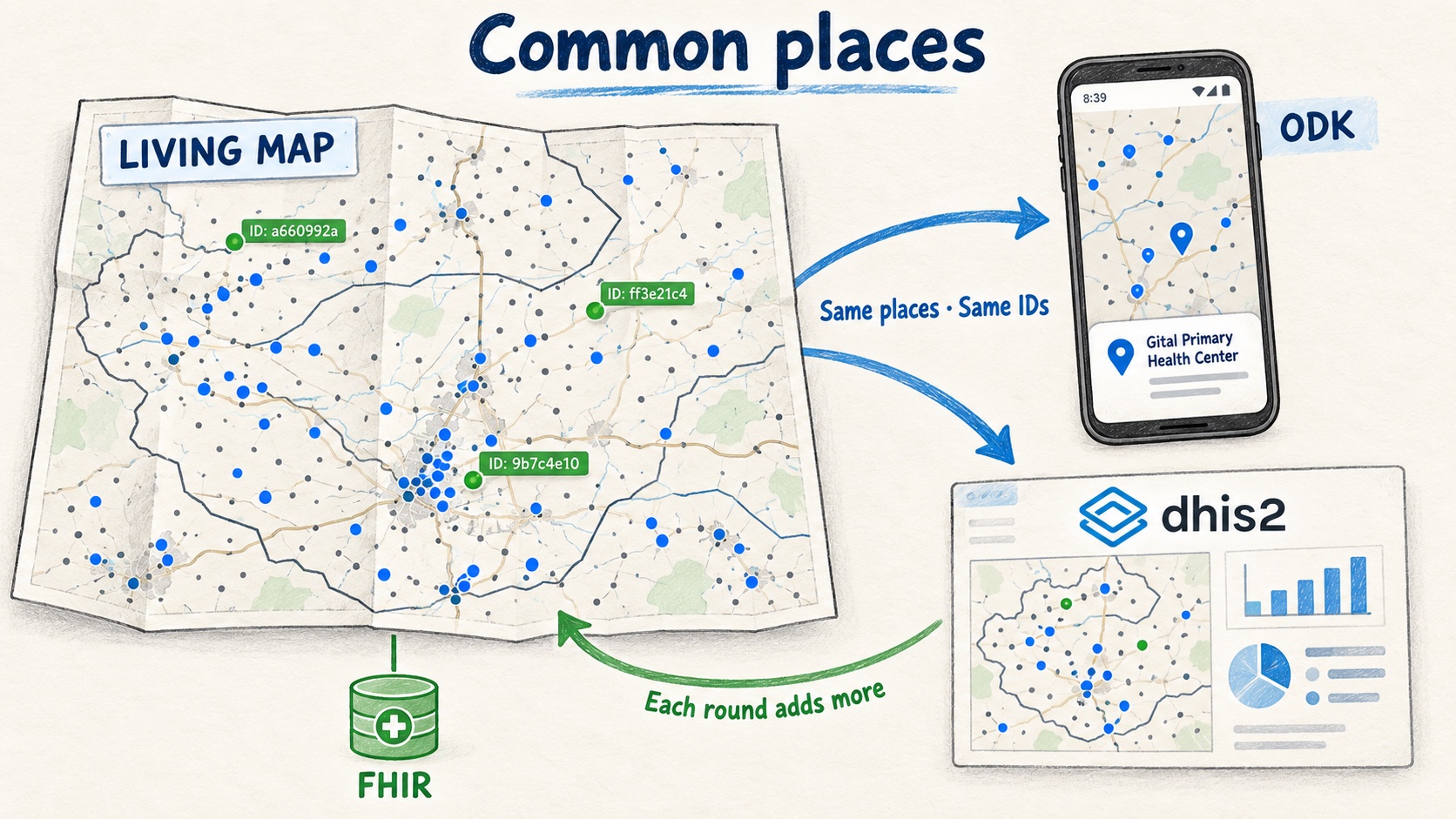
One common source of locations across tools. Stable place IDs and administrative boundaries, linked to health data in FHIR, load straight into field data collection tools such as ODK and DHIS2, so that what each round collects adds to a living map.
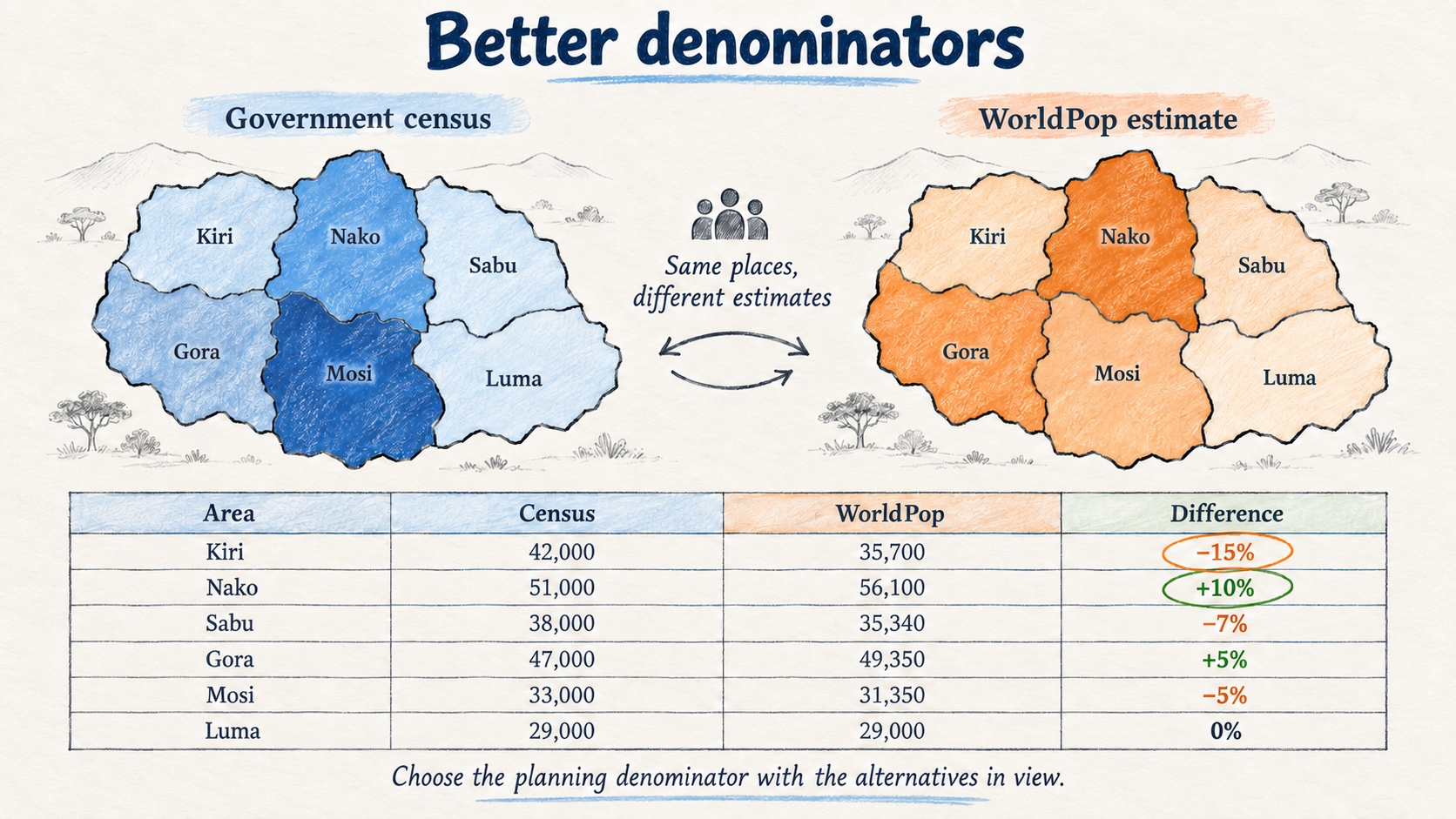
Better denominators
The ICR makes it easy to compare census, WorldPop, administrative, and last‑round figures side by side, so campaign teams choose their planning denominator with the alternatives in view.
Campaign visibility
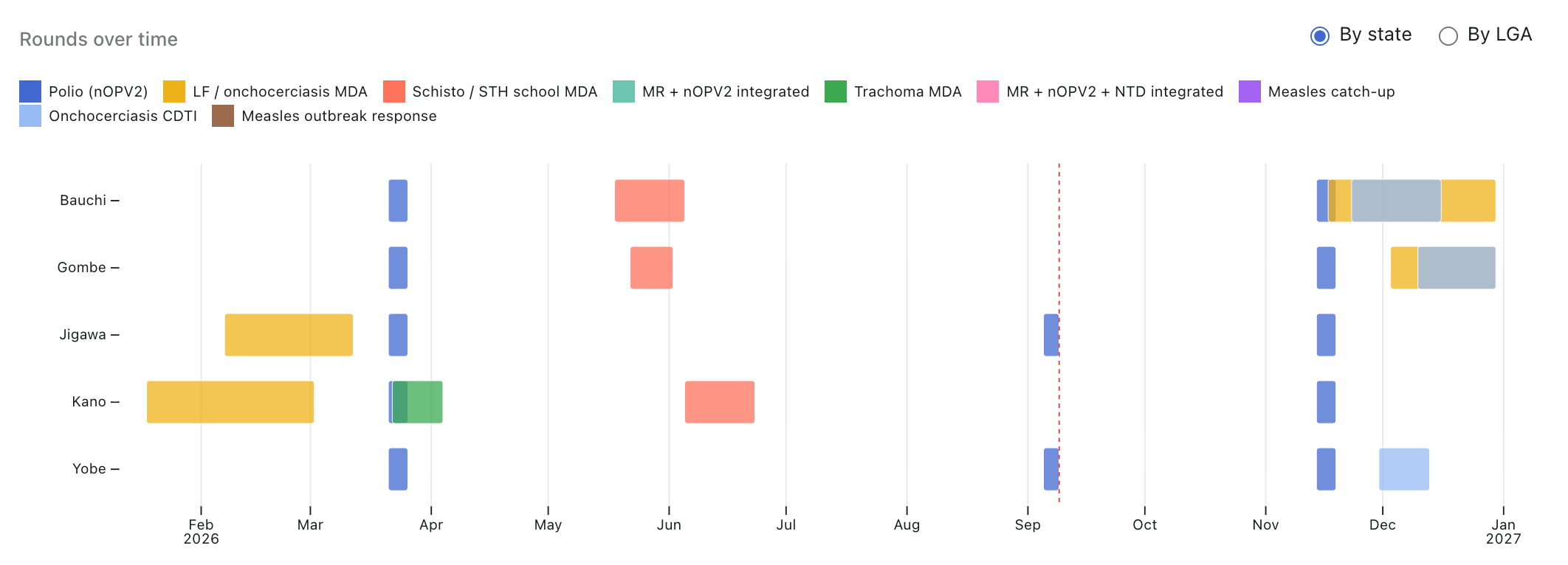
Every campaign is a record with geography, dates, and status, from microplan to completion. The ICR gives a centralized view of what is planned where that any programme can consult. When two campaigns are heading for the same wards within weeks of each other, the registry shows it making co‑delivery and integration practical.
Skip the pre‑census
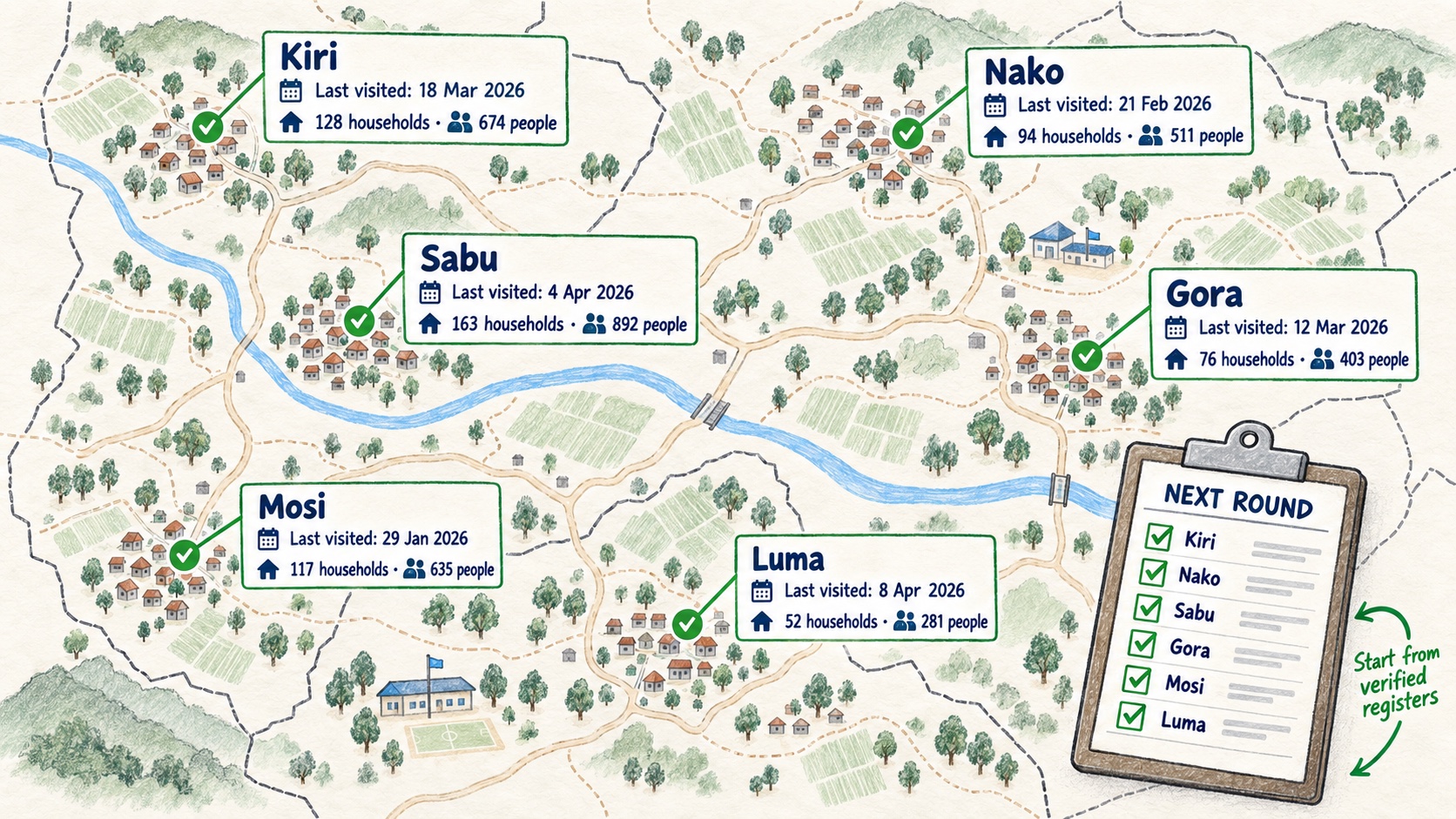
Households, delivery units, and teams persist from one round to the next, so a campaign can target from last round's registers instead of enumerating everyone again.
Effectiveness over time
The ICR stores campaign records in a standard, comparable form, so coverage trends, cost per person reached, and data quality can be tracked per place and per campaign type, within a country and across countries that share the standard.
Campaign‑to‑routine bridge
Campaign and routine records share the same facilities, places, and denominators in one store, with a single flag separating campaign doses from routine ones. The ICR is built on the same HL7 FHIR data model used to represent routine care.
How value compounds

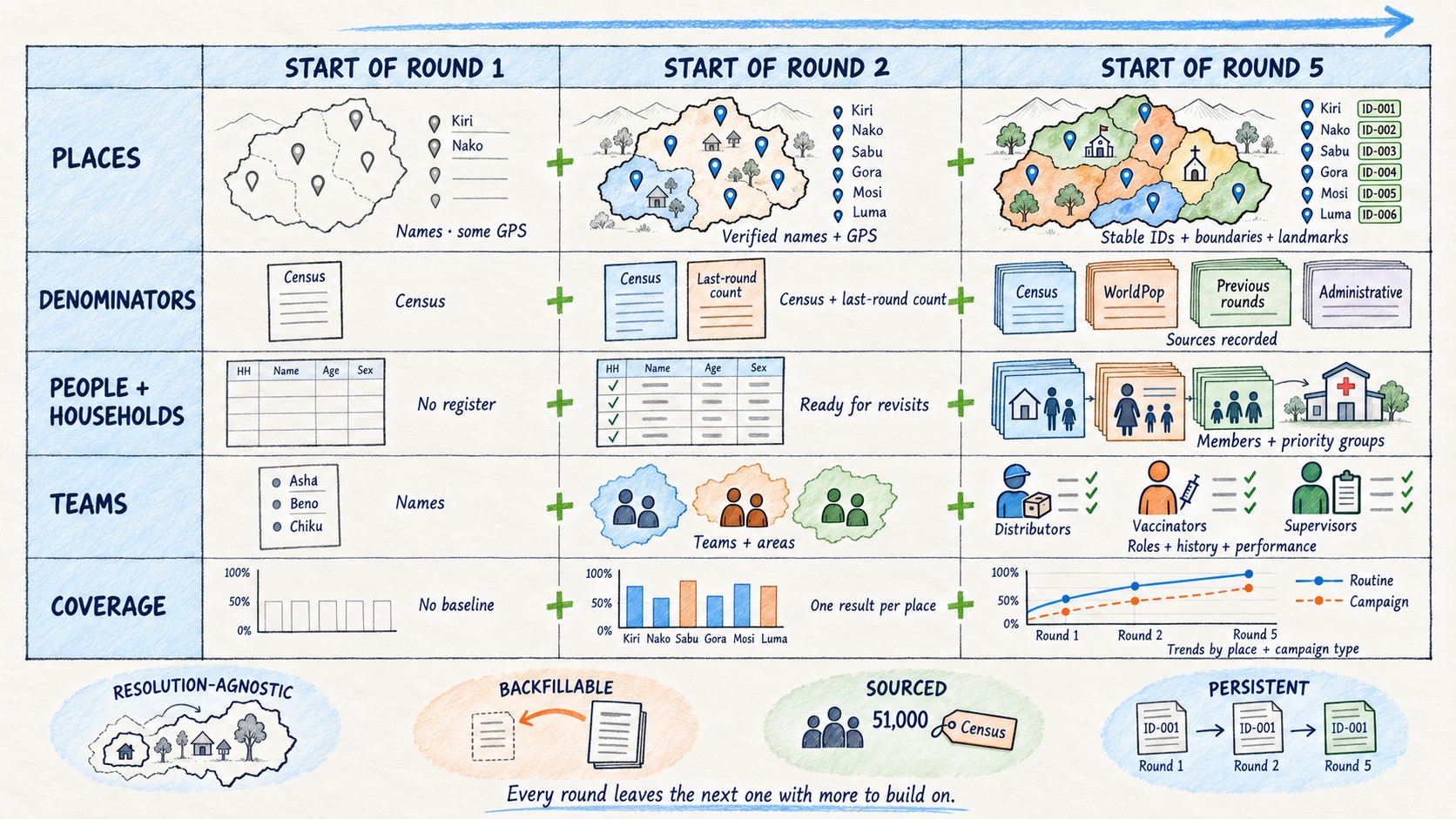
Every campaign round contributes to shared registries

Record
Start of round 1
Start of round 2
Start of round 5
Places
A list of settlement names, some with GPS points, some without
Every settlement visited last round, each with a GPS point and verified name.
A verified settlement map with stable IDs and boundaries, plus points of interest eg. the schools and churches that served as vaccination posts, etc.
Denominators
One estimate from the census projection
The census projection and last round's headcount, side by side
Census, WorldPop, previous‑round enumeration, and administrative figures side by side, each with its source recorded
People and households
No register yet
Last round's household register, ready for revisits
Household members including number of children and women of reproductive age known enabling further targeting and linkages to routine service delivery.
Teams
A list of names
Last round's teams and the areas each one covered
Community drug distributors, vaccinators, and supervisors with a history of which areas they covered and how they performed
Coverage
No baseline for these places
One coverage figure per place, from last round
A trend line per place per campaign type, with administrative and survey coverage kept separate

Key properties

Resolution‑agnostic

Household, village, or district: the ICR data model is designed to store however the data is captured.

Backfillable

The ICR is designed to take in past campaign data, so it can serve as the system of record for every round a country has run, not just the ones ahead.

Sourced

Every population figure and coverage result says where it came from, so a census projection is never mistaken for a field headcount.

Persistent

Places, households, and teams keep the same identifier from one round to the next.

Technical overview

Key ICR Components

Hand-drawn diagram titled 'How the ICR is built': tools countries already use (ODK, DHIS2, CommCare, GIS) connect through integration and enrichment steps (connect, match, geocode, validate) to a country-owned FHIR store holding campaigns, places, households, teams, denominators, and results, which feeds planning, analytics, and reporting. Underneath, the shared contract: the FHIR Implementation Guide and shared terminology.

Open‑source reference solution

Integration tools

A suite of connectors that automates the exchange of ICR data with the platforms countries already use, including ODK, DHIS2, and CommCare.

Matching and enrichment

Tools that deduplicate people, households, and places across sources, attach population figures to places, and find coordinates for settlement names.

Country‑owned FHIR store

The ICR provides a reference FHIR store that countries can use to host and manage their campaign data in country.

Analytics and reporting

The registry keeps a historical record of every campaign, with services delivered measured against estimated populations. It serves as a data warehouse for analysis across campaigns and over time, and can feed results into tools like DHIS2 for partner reporting.

The shared contract

FHIR Implementation Guide

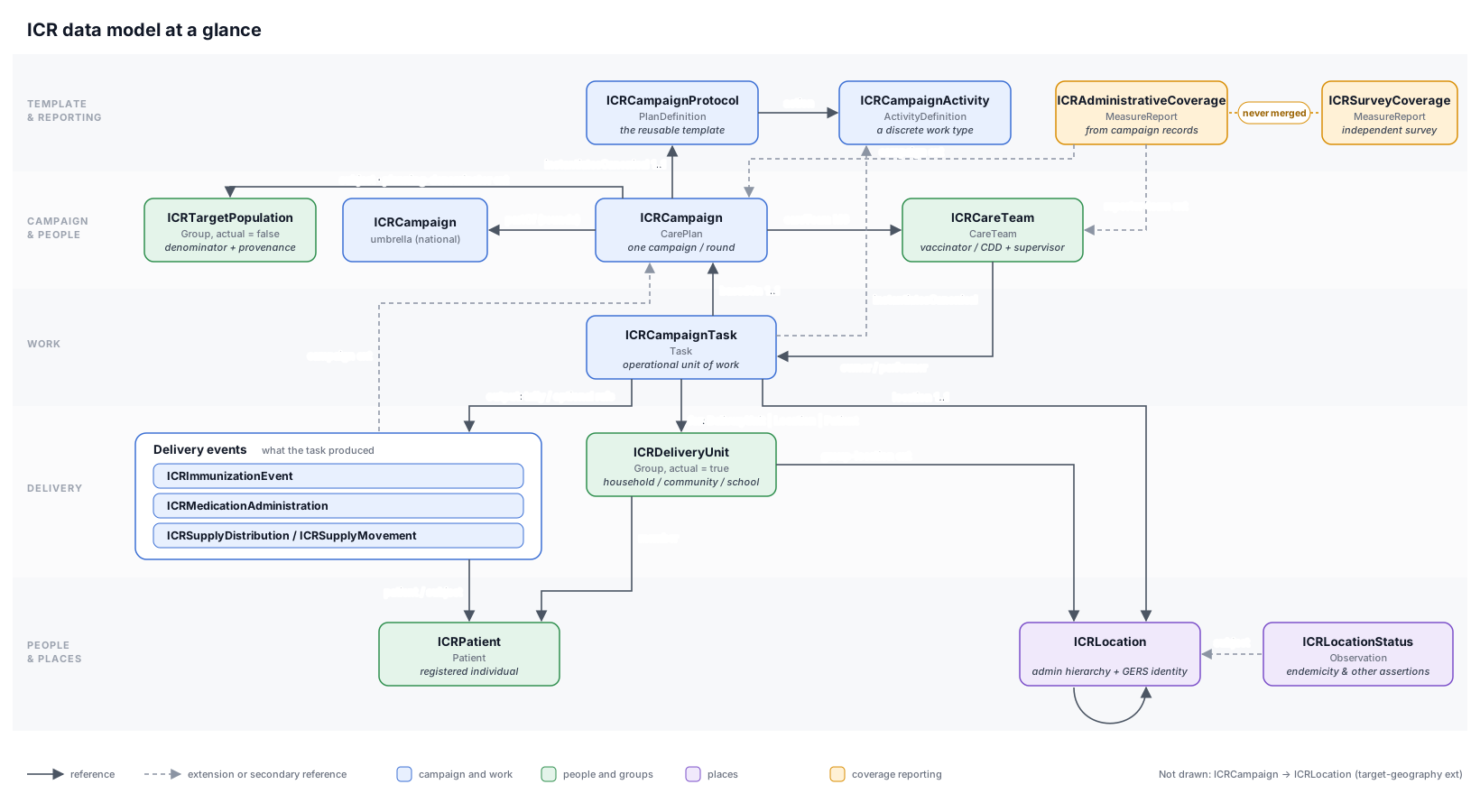
The ICR is based on a FHIR Implementation Guide. The IG uses FHIR profiles to adapt standard FHIR resources for campaigns: CarePlan for campaigns, Task for units of work, Location for places, and so on.

Shared terminology

Code systems and value sets cover campaign types, delivery strategies, missed reasons, team roles, and more, so forms and reports use the same codes everywhere.

Aligned with WHO SMART Guidelines

The ICR is built with the same toolchain as the WHO SMART Guidelines and is designed to be fully compatible with the Immunization guideline.

Global good

Developed by UNICEF with development partners, supported by the Gates Foundation, and released under an open licence.

Beyond campaigns

ICR bridges campaigns to routine care.

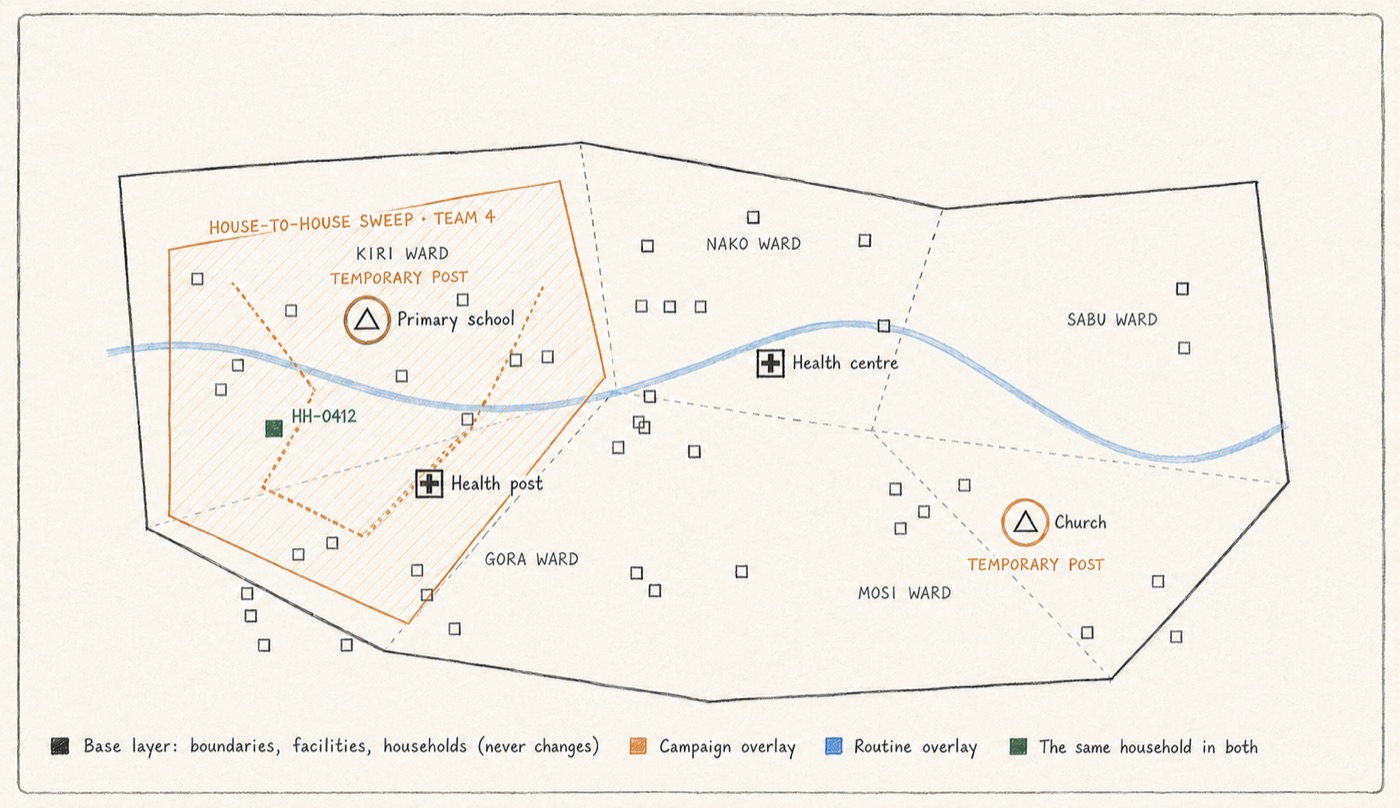
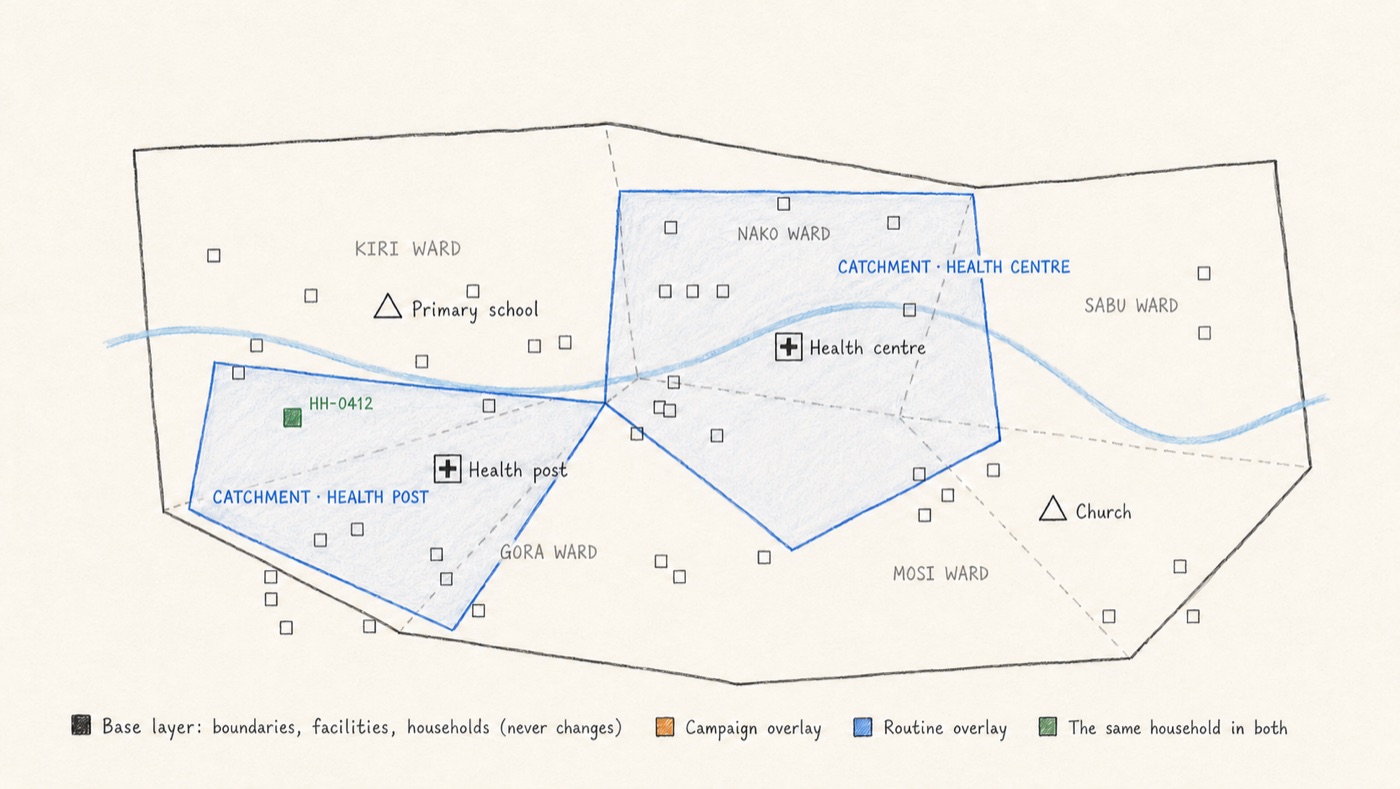
Campaigns share the same locations and underlying data that health systems need to deliver routine services. The HL7 FHIR data model the ICR is built on gives both a single, unified data model, bridging campaign and routine care.

Illustrative settlement map in campaign view: a house‑to‑house sweep area and two temporary posts at the primary school and the church, over the same wards, facilities, and households as the routine view Illustrative settlement map in routine view: catchments around the health centre and the health post, over the same wards, facilities, and households as the campaign view
Who benefits

Why the ICR matters to

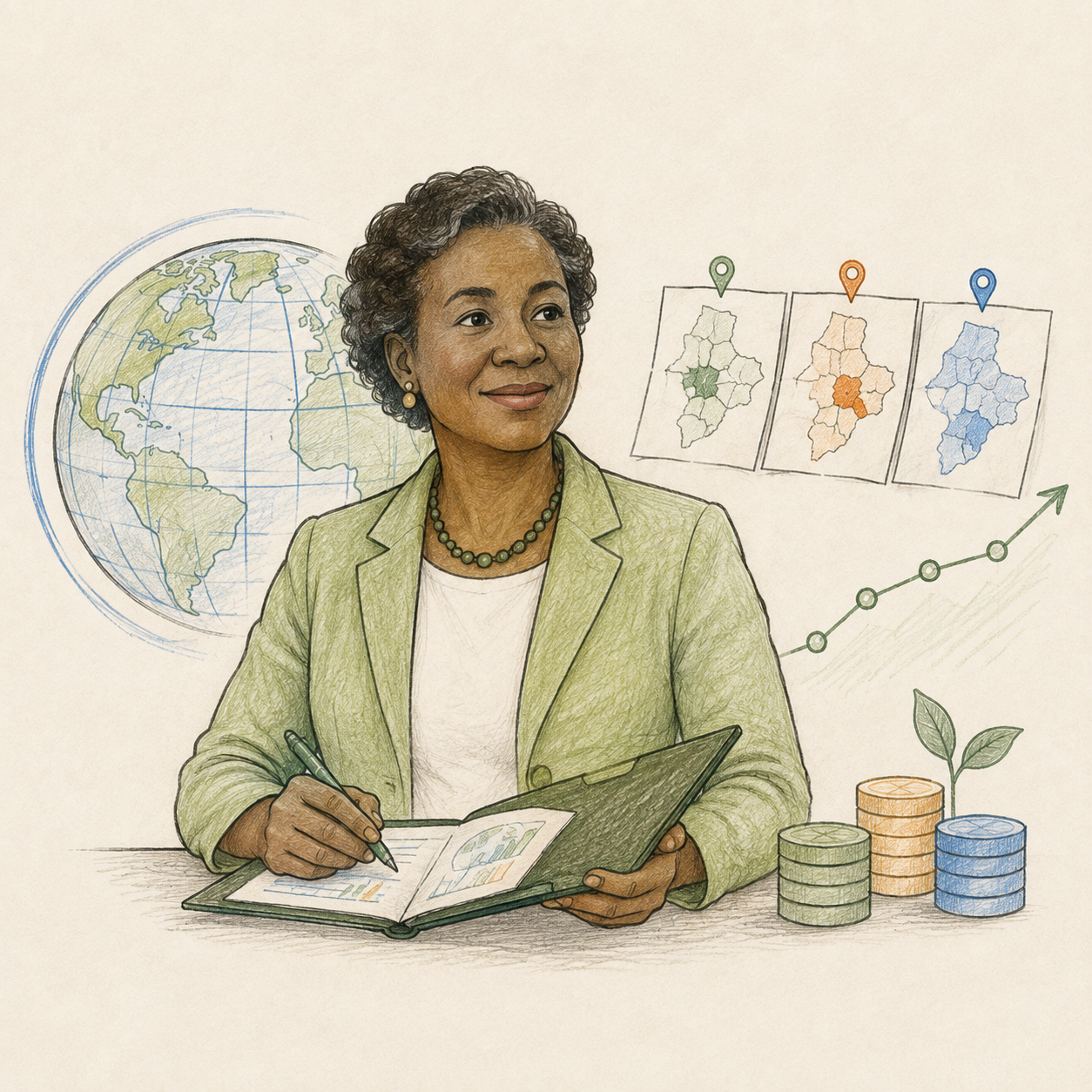
Illustration for donors and global partners

Donors and global partners

Gavi, GPEI, the END Fund, foundations, WHO and UNICEF headquarters.

They care about
Cost per round, comparability across countries, equity outcomes, and not funding the same enumeration five times.
Lead with
Skip the pre‑census · Effectiveness over time · Equity targeting · Validated aggregates
The story
The same two thousand villages received measles, polio, and lymphatic filariasis interventions within eighteen months and were enumerated three times. With the registry, the first campaign's enumeration is the second campaign's starting point, and the third campaign's coverage can be compared with the first.
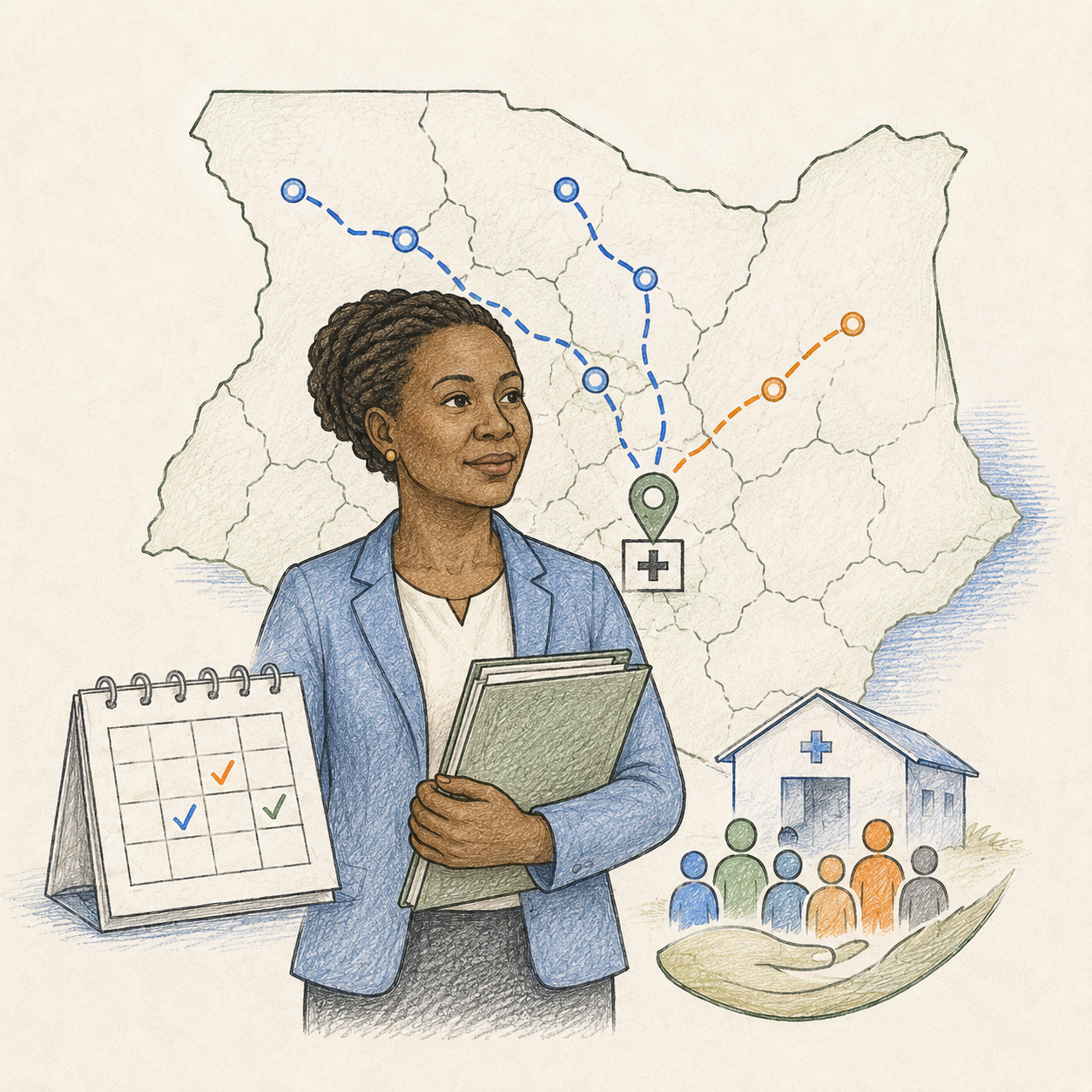
Illustration for national programmes

National programmes

EPI managers, NTD programme managers, health information system leads, planning directorates.

They care about
Ownership, denominators they can defend, and knowing what is happening in their own country.
Lead with
Campaign visibility · Denominators you can defend · Campaign‑to‑routine bridge · Common places
The story
The national campaign calendar as a live map built from the registry, rather than a spreadsheet one person maintains. Two programmes discover they are planning the same districts a month apart, and combine.
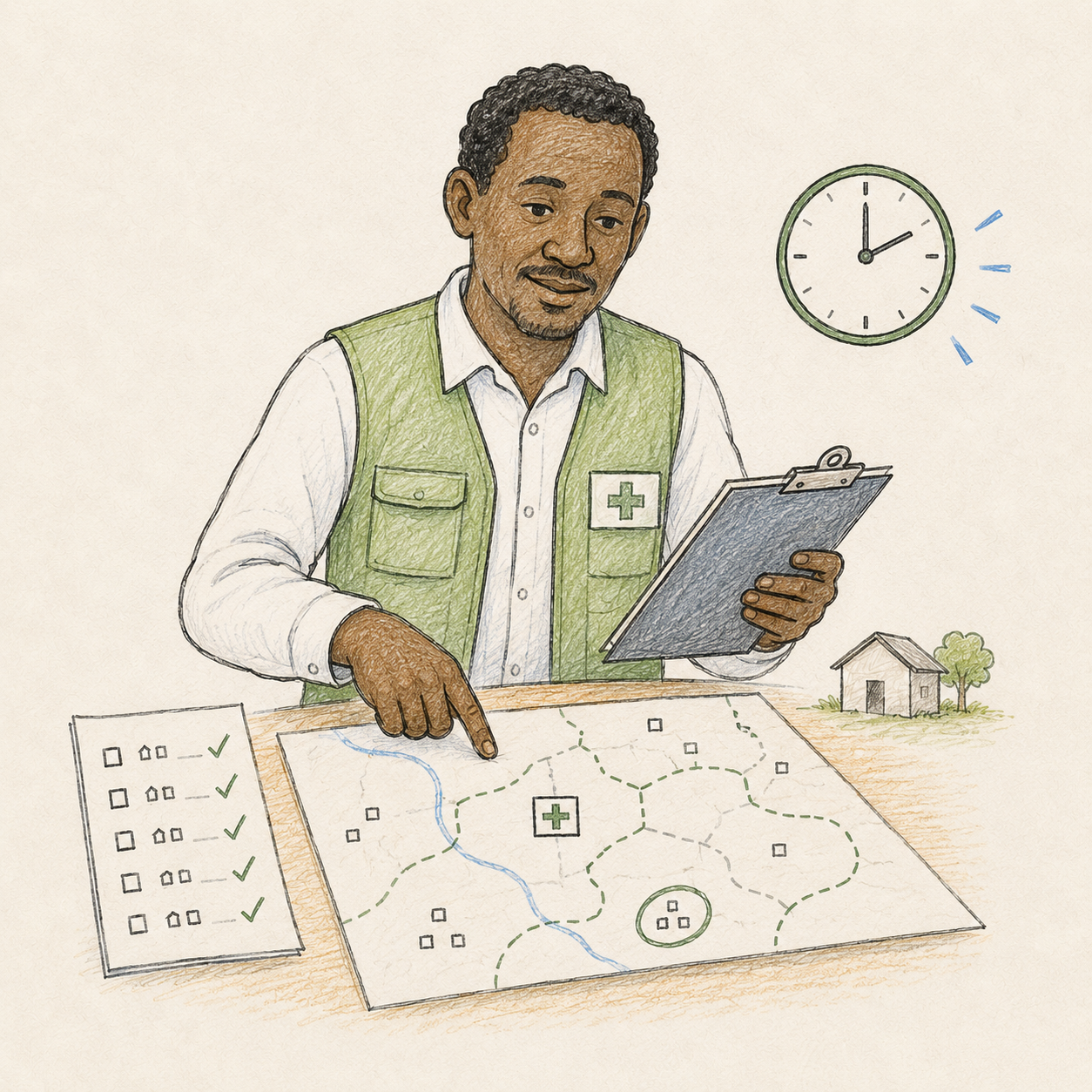
Illustration for district planners

District planners

District health teams, campaign coordinators, microplanning workshops.

They care about
Time. Weeks spent cleaning location lists, re‑enumerating, and re‑assigning teams.
Lead with
Common places · Skip the pre‑census · Visibility of what is coming to the district
The story
The next round starts from the last one. The settlement list, the posts used, the teams and their areas, and last round's per‑settlement coverage are the first page of the new microplan instead of the output of a three‑week exercise. The hamlet found last time is already on the list.
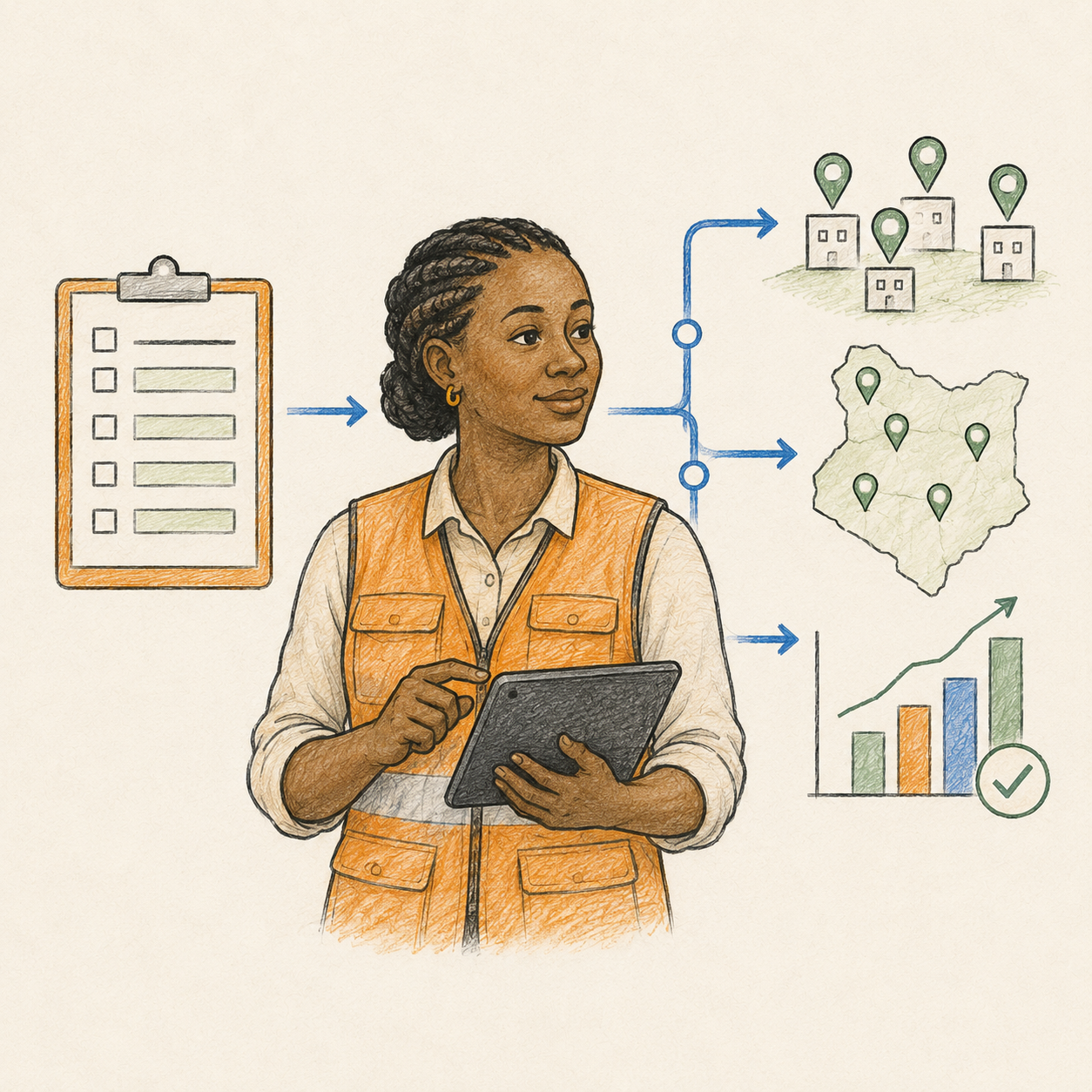
Illustration for implementers

Implementers

NGOs, campaign contractors, ESPEN and similar programmes.

They care about
Not rebuilding forms, location lists, and pipelines for every client and every country.
Lead with
Common places · Common model · Validated aggregates
The story
One form set and one integration pipeline that works in the next country because the target model is the same. The location list arrives from the registry instead of being built from scratch.
Illustration for technology partners

Technology partners

Data collection, GIS, warehouse, and reporting tool builders.

They care about
Integration surface and not being locked out.
Lead with
Common model · Common places · Reference solution, not platform
The story
Implement one profile set and interoperate with every other component in the reference solution. The IG defines the interface. Read the implementation guide ↗
Objections

Frequently Asked Questions

"Another standard nobody will adopt."
The ICR is based on the HL7 FHIR data standard which is the way most countries have decided to represent and store their national health data. The ICR is the first attempt to adapt the FHIR standard to represent campaigns.
"DHIS2 already does this."
DHIS2 does aggregate reporting and case tracking. It is not designed to be a standards based campaign model with places, teams, denominators, and protocols that carry across programmes. The ICR is designed to feed data into and out of DHIS2.
"This locks us into one vendor."
The ICR is an open standard and reference architecture that any country or tech provider can use. It is meant to compliment not replace existing platforms.
"Person‑level data in campaigns is a privacy risk."
The ICR data model can be uses to store aggregate (tally) level or individual data. The ICR provides mechanisms to control if and how individual level data can be shared between campaigns, partners, etc.
"We cannot compare across countries; contexts differ."
Adoption of the standard makes comparison between countries easier. Within‑country comparison across rounds, however, is the primary use.